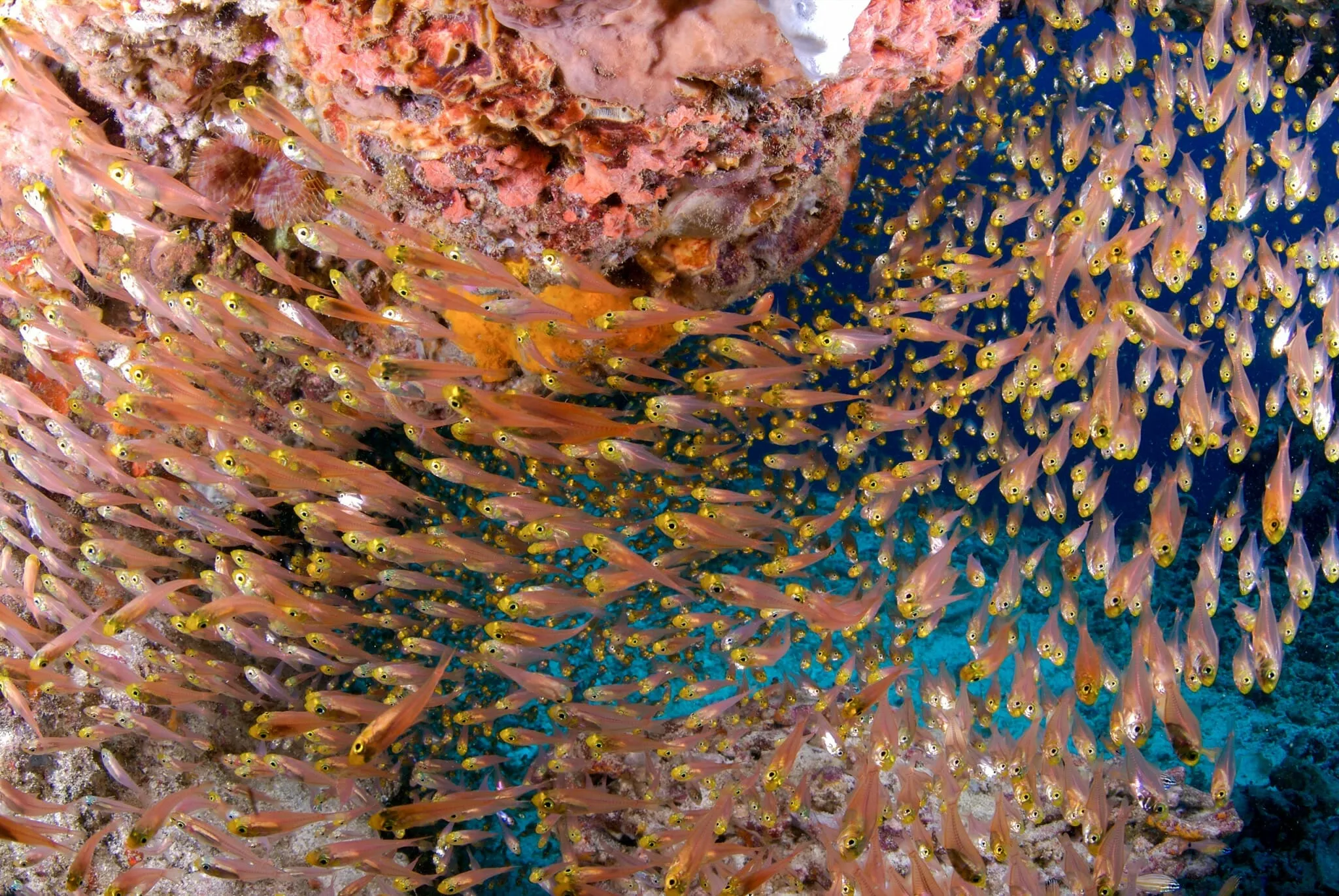
School of reef fish swimming above coral near Pom Pom Island

Pom Pom Dive Centre

Dive Sites

Explore nearby reefs, walls, slopes and macro-diving sites from Pom Pom Island.

Around Pom Pom

Diving Around Pom Pom

Surrounded by seven islands, Pom Pom is ideally located for divers to explore nearby sites and search for rare species.

Muck diving, also called macro diving, focuses on small subjects that typically measure from a few millimetres to a few centimetres long, such as nudibranchs, pygmy seahorses, ghost pipefish and flatworms.

At Pom Pom, divers enjoy relaxing dives while searching for coral fish and macro marine life. Nearby sites are reachable by fast boat in approximately 15 to 25 minutes.

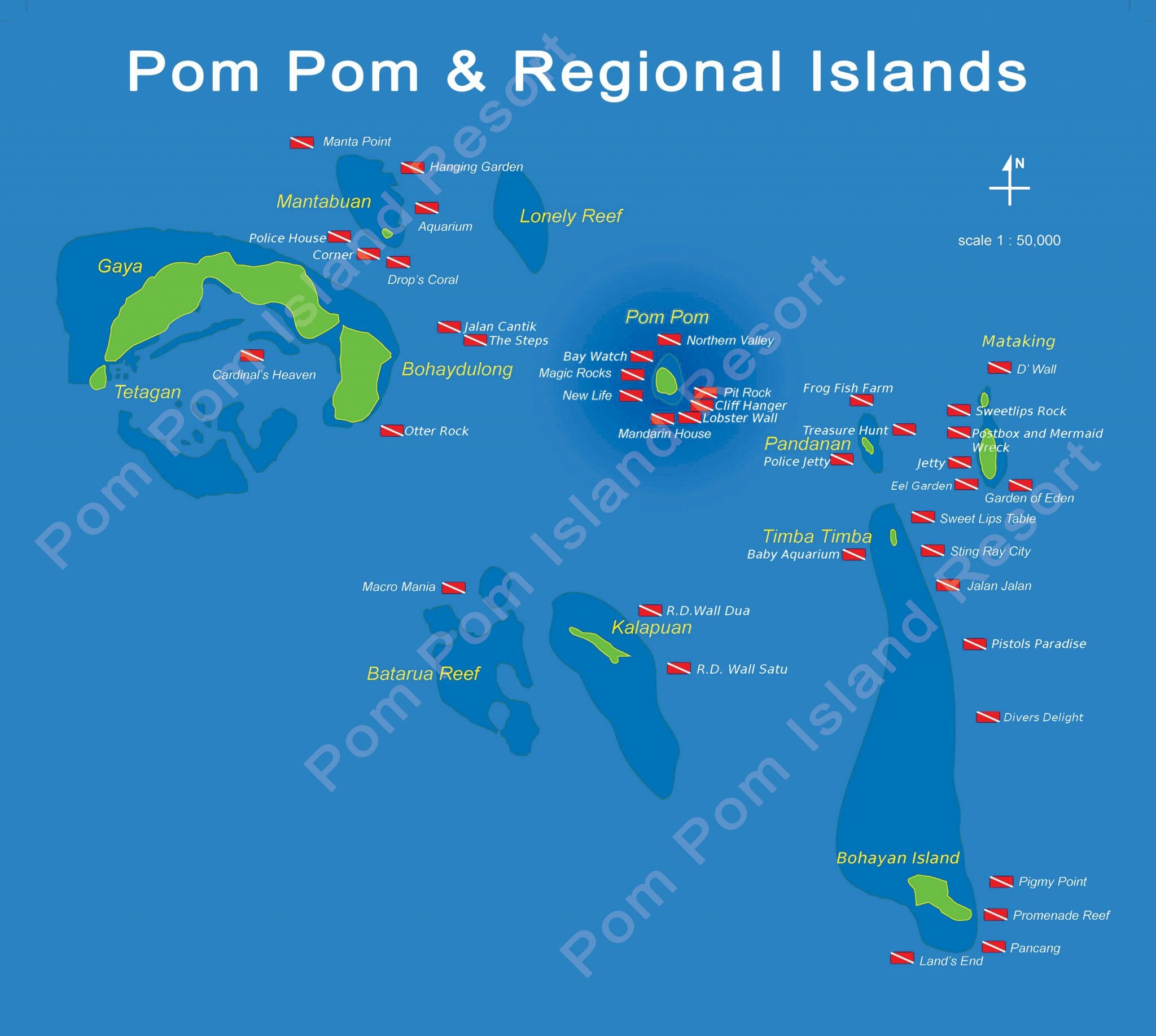
Pom Pom dive-site map showing the surrounding islands and marked dive sites

Islands at a Glance

Pom Pom Waters

Dive Sites Around the Island

Site Guide

Explore by Island

Pulau Pom Pom

Pom Pom

6 dive sites

Mandarin Heaven

A macro-lover’s paradise, Mandarin Heaven is accessible by boat and from the jetty by giant-stride entry. A gentle slope stretches from the shallow plateau at 5 metres to beyond 40 metres. Prominent coral heads host octopus, hinge-beak shrimps and other marine life, while artificial structures shelter ghost pipefish among colourful crinoids, together with common and zebra lionfish.

The rubble and soft-coral patches are home to nudibranchs, while two purpose-placed tyre piles at 8 metres provide shelter for twin-spot lionfish, banded and winged pipefish, trumpetfish, leaf scorpionfish and stonefish. Mandarin fish can be found among the sea urchins at 5 metres, and the shallows are visited by turtles, banded sea snakes and robust ghost pipefish.
Pit Rock

Pit Rock sits at the bottom of the buoy line at around 20 metres on a gradual rubble slope. Schools of glass fish swim around the rock, while leaf scorpionfish, hinge-beak shrimp, banded boxer shrimp and peacock mantis shrimp inhabit this small, biodiverse area.

The surrounding sloping reef is scattered with nudibranchs and resting sea turtles and continues in both directions.

Northern Valley

A shallow coral garden slopes down to well beyond 40 metres. The areas past 25 metres have the highest concentrations of coral and fish life and can be prone to strong currents, making the deeper section more suited to experienced divers.

Four large gorgonian fans dominate the area at around 27 metres and shelter pygmy seahorses. Trevally, batfish and fusilier schools add colour, while octopus, lionfish, blue-spotted stingrays and frogfish may be found in the shallower areas.

New Life

The dive begins with a steep sloping wall covered in cracks, holes and ledges. Farther along, the slope becomes gentler and opens onto coral heads and anemone-strewn sand patches. Juvenile fish, stonefish, scorpionfish, harlequin sweetlips, pinnate batfish, lionfish and crustaceans can be found here.

The area also provides resting grounds for turtles, while whip corals and sea fans extend into the nutrient-rich current.

Cliffhanger

A buoy line descends to around 18–20 metres. The dive begins along a wall with fans and whip corals before becoming less steep over a rubble and sandy bottom. The reef reaches a plateau at 50 metres, while mandarin fish, nudibranchs, shrimps and flatworms can be found across the rubble.

Turtles roam the site, painted spiny lobsters shelter in openings along the wall, and batfish, sweetlips and parrotfish are also found here.

Magic Rocks

Magic Rocks brings together many of Pom Pom’s underwater environments. Gorgonian sea fans rest on a plateau at approximately 30 metres, sand patches shelter bottom dwellers such as stargazers and stingrays, and the rubble-covered shallows are home to nudibranchs, small frogfish, mandarin fish, pipefish and octopus.

Leaf scorpionfish and banded boxer shrimp gather around the rocks alongside hinge-beak, cleaner and glass shrimp. Stonefish, scorpionfish, pinnate batfish and lionfish can also be found here.

Pulau Mantabuan

Mantabuan

4 dive sites

Hanging Gardens

Hanging Gardens features a black coral garden between 22 and 35 metres, with some pieces over a metre in height. Giant frogfish, sawblade shrimp and other crustaceans can be found among schooling reef fish, while tuna and rainbow runners may pass in the blue.

Aquarium

Aquarium is a sloping reef descending to around 35 metres, with minimal current, coral and abundant marine life. Moorish idols and batfish school around the site, while blue-spotted stingrays shelter beneath table corals. Frogfish wait among barrel sponges and staghorn corals, and ghost pipefish hide among crinoids and rubble on the sea floor.

Corner

With a maximum depth of around 15 metres, Corner is used as a second-dive site. Currents can be strong, while hard and soft corals host bannerfish, nudibranchs, green and hawksbill turtles and cleaner wrasse.

Drops Coral

Sandy patches hold nudibranchs and gobies, while coral outcrops shelter shrimp, scorpionfish and moray eels. Green and brown sponges may hide frogfish, and areas of brain and cabbage coral appear toward the end of the dive. Barracuda and bumphead parrotfish are also sometimes seen.

Pulau Timba Timba

Timba Timba

3 dive sites

Jalan Jalan

Timba Timba can be exposed to strong currents and offers drift diving. Turtles, bumphead parrotfish, trumpetfish and barracuda are found at Jalan Jalan. Its association with current makes it a site for more experienced divers unless conditions are favourable.

Sweet Lips Table

Sweet Lips Table is another drift dive, with depths passing 30 metres along a sloping wall. Harlequin and oriental sweetlips use this part of the reef as their home, and nesting titan triggerfish are also encountered.

Macro diving is possible, although the site’s association with strong currents means conditions do not always allow it.

Sting Ray City

Sting Ray City offers drift diving with blue-spotted stingrays, green and hawksbill turtles and macro life including peacock mantis shrimp, frogfish, ornate ghost pipefish and leaf scorpionfish.

The site is better dived nearer high tide as the current approaches its turning point. Hard corals cover the shallows, and a gradual slope extends past 30 metres.

Pulau Kalapuan

Kalapuan

1 dive site

R.D. Wall

The dive begins on a slope before reaching the wall. Nooks and crevices shelter boxer shrimp, dancing gobies, fire-dart gobies, nudibranchs, peacock mantis shrimp and coral-whip partner shrimp.

Batarua Reef

1 dive site

Macro Mania

Macro Mania is a site for underwater photography and macro life. Hairy squat lobsters, gobies, pipefish, orangutan crabs, nudibranchs, cuttlefish, octopus, flatworms, frogfish, partner shrimp and other crabs are among the subjects described here.

Pulau Mataking

Mataking

3 dive sites

Deep Wall

Located at the north of the island, Deep Wall can be exposed to strong currents and is described for more experienced divers. The shallows also offer macro life, including ribbon eels, leaf scorpionfish and cuttlefish.

Sweetlips Rock

Located near Pulau Mataking Kecil, Sweetlips Rock follows a gentle wall down to around 18 metres. Nudibranchs, flatworms and shrimp share the reef with oriental sweetlips, while green turtles can also be seen in the shallows.

Postbox Wreck & Sipadan Mermaid Wreck

An artificial reef was purposefully sunk in around 22 metres of water, where divers have found lionfish, shrimp, scorpionfish, jackfish and moray eels.

Pulau Bohayan

Bohayan

2 dive sites

Pygmy Point

Pygmy Point is a deep dive of around 30 metres and can be exposed to very strong current, making it challenging in some conditions. Gorgonian fans reach into the current and provide an environment for pygmy seahorses.

Pharaoh cuttlefish, leaf scorpionfish, peacock mantis shrimp, porcelain crabs and blue-spotted stingrays can be seen across the shallower reef. Eagle rays may also pass in the blue.

Lands End

A marker buoy and chain identify the starting point at Lands End. The reef wall drops beyond 30 metres and is covered with small fans and anemones, with hard corals in the shallows. The site can be open to strong currents and is used for drift diving.

Schools of fusiliers, bigfin reef squid, nudibranchs and other macro species including giant frogfish are found along the reef. Tuna and other ocean-dwelling fish may also pass in the blue.